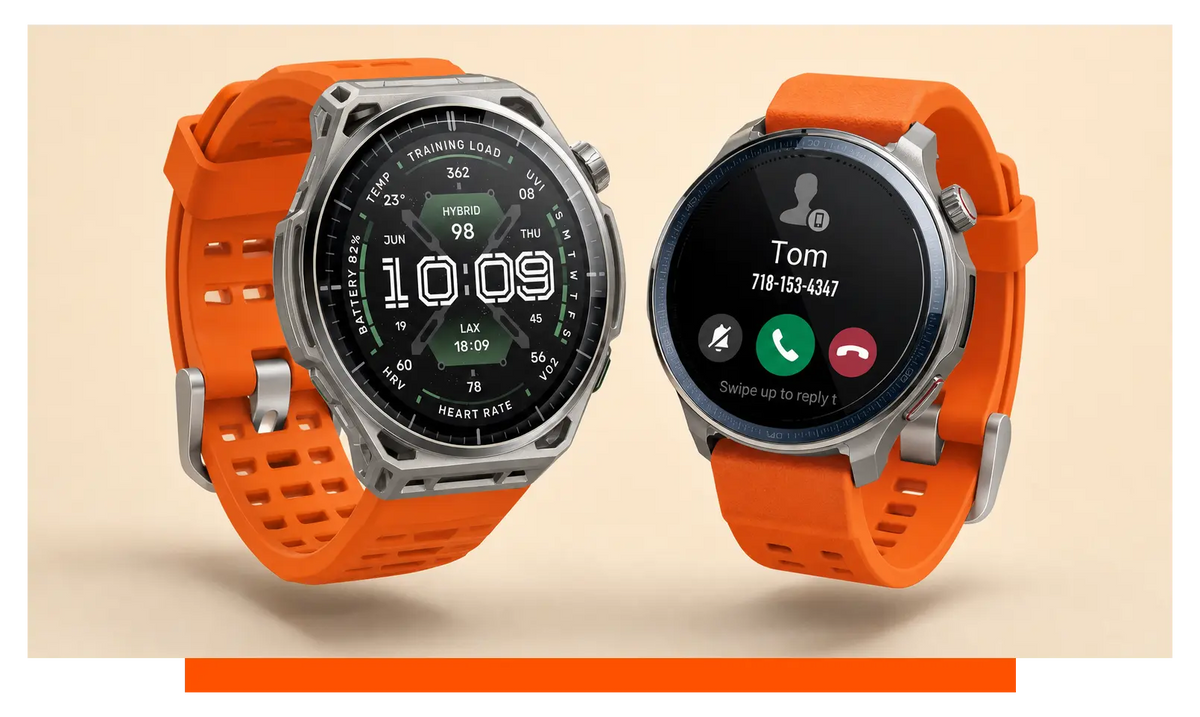
Comparison of the OnePlus Watch 4 and Oppo Watch X3
The Oppo Watch X3 suits buyers who need its region-specific eSIM option or prefer its finish, while the OnePlus Watch 4 is the value pick for most people. They are near-twins for battery, tracking and hardware; what decides it is whether local features and support justify the Oppo’s higher total ownership cost.
On this page
Use these links to move straight to the part of the comparison that matters to you.
- The short version
- Oppo Watch X3 and OnePlus Watch 4 specifications compared
- Are the regional features genuinely different?
- Price and total cost of ownership
- Oppo Watch X3 vs OnePlus Watch 4: battery life
- Charging speed and convenience
- Case size, weight and wrist fit
- Oppo Watch X3 vs OnePlus Watch 4: straps and comfort
- Display quality and outdoor visibility
- Location and sports tracking
- Health tracking and sensors
- Durability for daily wear and training
- Performance, apps and connectivity
- Where Oppo Watch X3 is better
- Where OnePlus Watch 4 is better
- Who should choose which
- Frequently asked questions
The short version
In short, these watches share far more than they separate.
- Price: at the time of writing, Oppo Watch X3 was listed at £329, while OnePlus Watch 4 was listed at £193.99 - £329, depending on version and provider . Check delivery charges, import status and warranty terms before treating the lower listing as the cheaper ownership route.
- Regional features: Oppo lists eSIM for its China version; OnePlus Watch 4 does not list eSIM. That matters if you want cellular use away from your phone, but it is not a universal Oppo advantage.
- Battery: their published battery figures match. Neither watch has an established endurance advantage in the supplied specifications.
- Hardware: the processor, memory, storage, location system, sensors and main connectivity are effectively matched.
- Fit: both have the same stated case dimensions and weight, and both accept standard quick-release replacement straps of the same width.
- Buying decision: choose around regional functions, seller support, final delivered cost and the case-and-strap combination you actually want to wear.
The decisive trade is regional entitlement and buying confidence versus price, not a meaningful performance gap.
Oppo Watch X3 and OnePlus Watch 4 specifications compared
The specification sheet confirms the central point: regional availability and buying cost separate these watches more clearly than their core hardware.
| Specification | Oppo Watch X3 | OnePlus Watch 4 |
|---|---|---|
| Regional feature availability | eSIM (China) | No eSIM |
| Price at the time of writing | £329 | £193.99 - £329 |
| Battery life | Up to 5 days; up to 3 days; up to 16 days | 5 days; 3 days; 16 days |
| Case and supplied strap | Titanium alloy (TC4); Strap × 1 | Titanium alloy; Strap × 1 |
| Charging | 10 mins charge for 1 day | About 7.5 W; about 75 minutes |
| Dimensions and weight | 47.4 mm × 47.4 mm × 11.0 mm; 43 g | 47.4 mm × 47.4 mm × 11.0 mm; 43 g |
| Display panel | LTPO AMOLED | LTPO OLED flexible display |
| Display resolution | 466 × 466 | 466 × 466 pixels |
| Peak brightness | 3000 nits | 3000 nits |
| Location technology | Dual-band L1+L5; Beidou, GPS, Galileo, GLONASS, QZSS | Dual-band L1+L5; Beidou, GPS, Galileo, GLONASS, QZSS |
| Durability | MIL-STD-810H; 5ATM; IP69; IP68 | MIL-STD-810H; 5ATM; IP69; IP68 |
| Processor | Qualcomm Snapdragon W5 Processor | Qualcomm Snapdragon W5 Processor |
| Memory and storage | 2GB RAM; 32GB ROM | 2GB RAM; 32GB ROM |
| Sensors | ECG sensor; wrist temperature sensor | ECG sensor; wrist temperature sensor |
| Health tracking | 60s Wellness Overview | 60s Wellness Overview |
| Sports tracking | 100+ sports modes; 6 automatic recognition | Over 100 sports modes; 6 automatic recognition |
| Smartwatch features | Google Play; Gemini | Google Play; Gemini |
| Connectivity | WLAN 2.4G/5G; Bluetooth 5.2; NFC | WLAN 2.4G/5G; Bluetooth 5.2; NFC |
| Software and phone compatibility | Android 9.0 and above; iOS not supported | Android 9.0 and above; iOS not supported |
Are the regional features genuinely different?
Yes, but the established difference is specific rather than a broad hardware divide: Oppo lists eSIM for the China version, whereas OnePlus Watch 4 has no eSIM.
That can completely reverse the recommendation if your chosen Oppo version, mobile network and region let you use cellular service without carrying your phone. It is useful for a run, a quick errand or any other time when leaving a handset behind is the point. It should not be treated as a guaranteed feature of every Oppo Watch X3 sold through every route, however.
Regional health functions deserve the same care. Approval and registration can affect whether a feature is enabled where you live, so a logo on the box or a feature shown on another region’s product page does not necessarily establish local access. Confirm the exact regional model and its enabled services before paying a premium.
Support belongs in this calculation too. A watch bought through an unfamiliar import route may be attractively priced, but returns, network activation and warranty handling can be less straightforward than with a clearly supported local purchase. On your wrist, the difference is simple: only a properly supported regional feature changes what the watch can do away from your phone.
Price and total cost of ownership
OnePlus Watch 4 has the stronger value case at the listed prices, provided its seller, delivery route and warranty terms work for you.
At the time of writing, Oppo Watch X3 was listed at £329 and OnePlus Watch 4 at £193.99 - £329 . That is a substantial enough separation to make the buying route part of the product comparison. The headline amount is only the start: delivery charges, possible import costs, return postage and warranty access all affect what you ultimately spend.
The included strap also has a small but real ownership cost. Both watches come with a strap, but a supplied band that does not suit your skin, training or clothes is likely to be replaced quickly. Because both watches use a standard fitting, that change is easy; it still belongs in your initial budget.
The Oppo can justify more if its regional eSIM support, finish or sales support solves a need the OnePlus cannot. If those benefits do not apply to you, paying extra does not buy a better processor, a brighter display or longer published battery life. What you will notice after purchase is not extra speed, but whether you saved money without making returns and support more awkward.
Oppo Watch X3 vs OnePlus Watch 4: battery life
Battery life is a draw on the published figures, with both watches quoting matching endurance across their stated usage modes.
Oppo gives up to 5 days, up to 3 days and up to 16 days; OnePlus lists 5 days, 3 days and 16 days. Those modes are useful boundaries, but your result will move with display use, location tracking, notifications, health measurements and app activity. The important buying point is that neither brand establishes an advantage here.
The supplied information does not isolate a continuous GPS workout figure, so there is no sound basis for declaring either watch the longer-lasting training companion. If you record long walks, rides or runs, compare like-for-like settings and leave headroom rather than treating a general-use claim as a workout promise.
For everyday ownership, equal published endurance shifts attention back to charging habits and regional features. You should expect broadly similar planning rather than buying one specifically to escape the charger. The practical wrist-level result is a tie: neither model gives you an evidence-backed extra day over its near-twin.
Charging speed and convenience
Oppo supplies the more useful quick top-up claim, while OnePlus states a fuller charging time and approximate power figure.
Oppo says a 10 mins charge provides 1 day of use. That is the more reassuring promise if you regularly notice a low battery just before work or training. OnePlus states about 7.5 W and about 75 minutes, which is easier to plan around when you want a complete charge rather than a brief rescue.
These claims are framed differently, so they do not prove that one charging system is faster under identical conditions. Temperature, remaining charge and charger setup can all shape a real session. It is better to use the figures for planning than to turn them into a race the available evidence cannot settle.
If you charge while showering or getting ready, Oppo’s short top-up statement is the more actionable of the two. If you normally recharge overnight or at a desk, the distinction is unlikely to outweigh seller support or price. Day to day, you would notice the Oppo’s clearly stated emergency top-up rather than a proven difference in complete charging speed.
Case size, weight and wrist fit
Case fit is effectively identical because both watches have the same stated dimensions and weight.
Each case measures 47.4 mm × 47.4 mm × 11.0 mm and weighs 43 g. That gives you a large, easily glanced-at face for maps, workout data and notifications, but it also means neither is the natural small-wrist option. If one looks broad on your wrist, the other is unlikely to solve that purely through case dimensions.
The Oppo specification names TC4 titanium alloy, while OnePlus states titanium alloy. That wording may matter to a buyer interested in the exact case description, but the supplied data does not establish a meaningful weight advantage: both land on the same figure.
Fit can still feel different once colour, finish and strap tension enter the picture. A flexible band can let a broad case sit more securely, while a stiff or loose strap makes the same watch feel more top-heavy. What you would actually feel is the shared large-case presence; the band choice has more scope to change comfort than switching between these cases.
Oppo Watch X3 vs OnePlus Watch 4: straps and comfort
Strap fit is another draw: both watches take standard 22mm quick-release straps, which makes comfort easier and less costly to personalise.
Our fitment catalogue confirms that Oppo Watch X3 straps use the standard quick-release fitting. We stock silicone, nylon, leather, milanese and metal choices for the watch. That range lets you move away from the supplied band without relying on a proprietary connector.
The same is true of OnePlus Watch 4 straps: our catalogue records the same 22mm quick-release fit and the same spread of silicone, nylon, leather, milanese and metal options. It is a genuine total-cost advantage shared by both watches because replacement choices are not confined to a rare connector.
- Silicone is the practical choice for running, swimming and sweaty gym sessions because it is easy to rinse.
- Nylon suits all-day wear when softness and fine adjustment matter more than a formal look.
- Leather makes either large sports watch easier to wear at work or with smarter clothes.
- Milanese and metal give the case a more traditional watch-like finish, though they are less natural for hard training.
The connector is not a reason to choose between the watches. The useful difference comes from selecting a material that stops the shared large case moving around. On your wrist, a well-fitted nylon or silicone band is likely to change comfort more than either badge on the case.
Display quality and outdoor visibility
Display quality is essentially level, with matching resolution and peak brightness alongside closely related LTPO panel descriptions.
Both displays have a 466 × 466 resolution and reach a stated 3000 nits at peak. That high peak figure is intended to preserve readability when sunlight is strong, while the matching pixel count means neither has an established sharpness advantage for maps, text or workout fields.
Oppo calls its panel LTPO AMOLED; OnePlus describes an LTPO OLED flexible display. Those labels are not enough to support a decisive visual-quality win. More important for everyday use will be the chosen watch face, brightness behaviour and how much information you ask the large display to show at once.
This is another area where paying more does not produce an evidenced specification gain. Both should offer a bright, detailed view, so colour and case finish can sensibly carry more weight if appearance matters to you. During an outdoor run, you would notice the shared bright display rather than a clear winner.
Location and sports tracking
Location and sports tracking are matched on paper, so neither watch has a proven training advantage from the supplied specification.
Both use dual-band L1+L5 location technology with Beidou, GPS, Galileo, GLONASS and QZSS. Dual-band reception is the useful part for runners and cyclists: it is intended to improve positioning where buildings, trees or difficult terrain interfere with satellite signals, helping recorded routes follow corners more cleanly.
Each watch also lists more than 100 sports modes and 6 automatically recognised activities. A long mode list gives you suitable labels for varied sessions, but it does not by itself establish better coaching or more accurate measurements. The matching location hardware is the stronger comparison point.
No separate continuous GPS endurance figure was supplied, so long-distance athletes should not infer one from the general battery claims. Route accuracy and battery consumption also depend on settings and conditions. Out on a run or ride, you should expect very similar route-recording tools; regional functions and purchase support remain the more credible tie-breakers.
Health tracking and sensors
Health hardware is tied, with both watches listing ECG and wrist-temperature sensors plus the same quick wellness overview.
Each model offers a 60s Wellness Overview, bringing several readings into a brief check rather than making you open separate screens. That is convenient for spotting patterns and maintaining a routine, but it should be treated as personal tracking rather than a substitute for professional medical assessment.
The important complication is regional enablement. ECG availability can depend on local certification and registration, so matching sensors do not guarantee matching active features in every place or on every imported version. This is exactly where the central buying rule applies: confirm the feature on the version you can actually buy, not merely on a specification page from elsewhere.
If a locally supported Oppo version enables something the OnePlus route does not, that can justify choosing it despite the otherwise shared hardware. Without that regional advantage, the sensor list gives neither watch a reason to cost more. In daily use, access to an enabled feature matters; the identical sensor name does not.
Durability for daily wear and training
Durability is a draw because both watches carry the same stated water, dust and ruggedness ratings.
Each lists MIL-STD-810H, 5ATM, IP69 and IP68. Together, those ratings make either model a practical choice for commuting, outdoor exercise and wet training conditions, provided you follow the manufacturer’s care guidance and avoid assuming every form of water exposure is equivalent.
Strap material still affects how rugged the whole setup feels. A rinsable silicone band makes more sense for repeated sweaty sessions, while leather is better kept for drier daily wear. Since both watches share a standard connector, you can change that part of the setup rather than choosing the device solely around its supplied strap.
There is no established durability reason to pay more for the Oppo or to prefer the OnePlus. What you would notice is shared confidence against everyday knocks and weather, with your replacement strap doing much of the work in keeping the watch comfortable afterwards.
Performance, apps and connectivity
Performance, apps and core connectivity are effectively equal, leaving no established speed or storage advantage for either watch.
The shared processor, memory and storage specifications point to the same class of app experience. Both list Google Play and Gemini, so their everyday smartwatch proposition covers downloadable apps and Google’s assistant experience rather than forcing a choice between different ecosystems.
Wireless specifications also match: both list dual-band WLAN, Bluetooth and NFC. That supports the usual phone connection, network access and compatible contactless functions, although the availability of individual services can still depend on your bank, market or account.
This section reinforces why price and regional support matter so much. The underlying hardware does not establish one as the faster or more capable general smartwatch. When you tap through apps or check a notification, any difference is more likely to come from setup and regional service access than from the processor inside.
Where Oppo Watch X3 is better
Oppo Watch X3 is better when its specific regional functions or purchase route solve a need the OnePlus cannot.
- Cellular option: the China version lists eSIM, while OnePlus Watch 4 lists no eSIM.
- Quick-charge guidance: Oppo states that 10 mins of charging provides 1 day, which is useful when you need a short top-up.
- Case specification: Oppo explicitly identifies TC4 titanium alloy, giving buyers a more precise material description.
- Right regional package: it is the stronger choice if the exact version available to you has an enabled health or cellular feature you will use and straightforward support.
Where OnePlus Watch 4 is better
OnePlus Watch 4 is better on value when you can buy it through a route with acceptable delivery, returns and warranty support.
- Lower listing: at the time of writing, OnePlus Watch 4 was listed at £193.99, against £449 for Oppo Watch X3.
- Matched essentials: it retains the same stated battery figures, case dimensions, weight, peak brightness, location technology and core sensors.
- No hardware premium required: the supplied specifications establish no processor, memory or storage disadvantage.
- Easy strap ownership: its standard 22mm quick-release fitting gives you broad replacement choice without a proprietary connector.
Who should choose which
Most buyers should choose OnePlus Watch 4 for value, while Oppo Watch X3 makes sense when a confirmed regional feature or preferred buying route outweighs the price difference.
- Choose Oppo Watch X3 if you need the China version’s eSIM option and have confirmed that activation works for your intended setup.
- Choose Oppo Watch X3 if a locally enabled health feature, finish or support arrangement is worth paying more for.
- Choose Oppo Watch X3 if its clearly stated quick top-up claim better fits a routine built around brief charging windows.
- Choose OnePlus Watch 4 if you want the shared core hardware and battery claims at the stronger listed value.
- Choose OnePlus Watch 4 if you train regularly but do not need cellular use away from your phone.
- Choose OnePlus Watch 4 if you can obtain it with clear warranty and return terms rather than relying on an awkward import route.
- Choose either if strap flexibility is your concern: both accept the same standard fitting and have silicone, nylon, leather, milanese and metal options in our catalogue.
If you are also weighing the previous OnePlus generation, our OnePlus Watch 3 vs OnePlus Watch 4 comparison covers that decision separately.
The final call: buy the OnePlus for near-identical essentials at better value unless the Oppo version available to you provides a regional feature or support advantage you can name and use.
Frequently asked questions
These answers cover the compatibility and fit questions that can still affect your decision.
Do Oppo Watch X3 and OnePlus Watch 4 work with an iPhone?
Short answer: No. Both watches require an Android phone with Android 9.0 or later and do not support iOS, so neither is suitable if an iPhone is your main handset.
Does ECG work in my country?
Short answer: It depends. ECG availability is tied to local certification and registration, so confirm support for the exact regional version before buying if this feature matters to you.
Is either watch suitable for swimming and sweaty gym sessions?
Short answer: Yes. Both have 5ATM, IP68 and IP69 ratings and include swimming workout modes, making them suitable for pool sessions and sweaty training when used within the manufacturer’s guidance.
Can I use my older Oppo Watch or OnePlus Watch straps?
Short answer: Only if the older band uses a standard 22mm quick-release fitting. Proprietary or integrated straps from older models will not fit these watches.
Is there a smaller alternative for slim wrists?
Short answer: Yes. OnePlus Watch 3 43mm has a 43.2mm case and fits wrists from 130mm, compared with the 47.4mm cases and 140mm minimum wrist size of Oppo Watch X3 and OnePlus Watch 4.