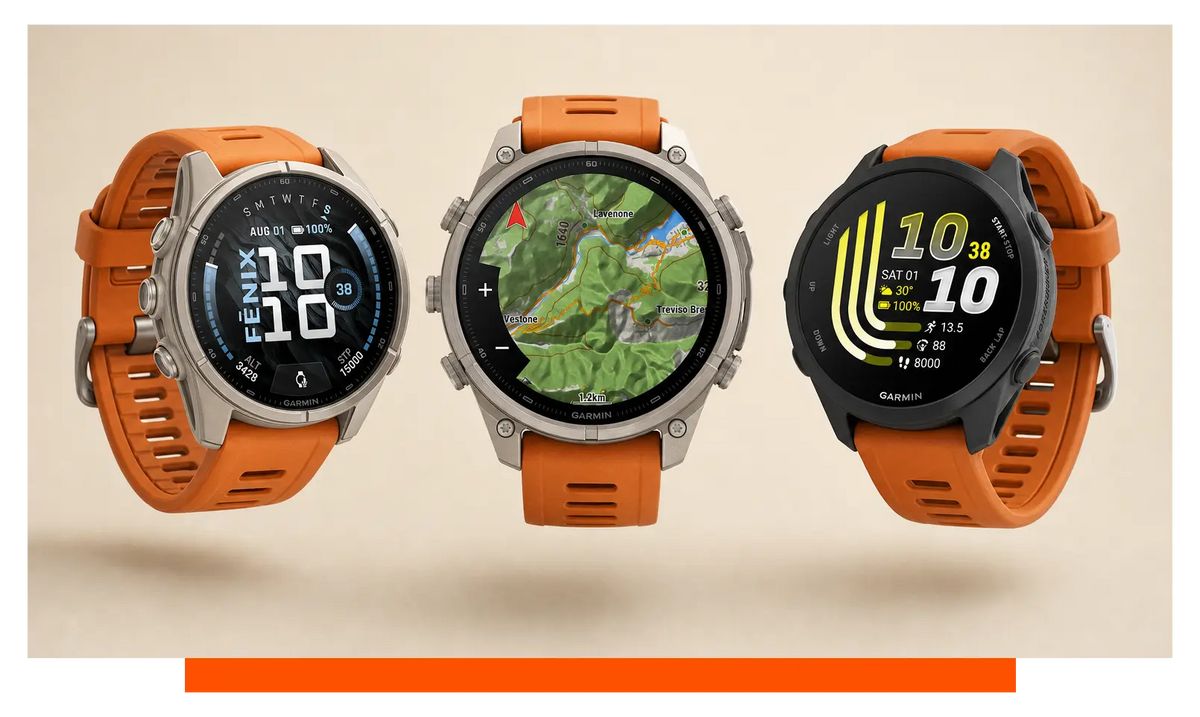
Garmin Enduro 4 is worth the jump for Enduro 3 owners who regularly navigate unfamiliar routes and need more offline storage or its newer training tools. Garmin Enduro 3 remains the smarter choice for everyone else. The deciding factor is whether those navigation and onboard-storage gains will materially change how you train or explore.
On this page
Use these links to jump straight to the part of the upgrade decision that matters to you.
- The short version
- Garmin Enduro 4 and Enduro 3 specifications compared
- Is Garmin Enduro 4 worth upgrading to from Enduro 3?
- Navigation and map handling
- Onboard storage
- Training tools and software
- Battery life
- Straps, comfort and everyday wear
- Case size, materials and weight
- Display quality
- GPS and water resistance
- Health and sports tracking
- Smartwatch features and platform
- Where Enduro 4 is better
- Where Enduro 3 is better
- Who should choose which
- Frequently asked questions
The short version
Most Enduro 3 owners can keep their watch without giving up the battery life, display or core outdoor features that define the range.
- Choose Garmin Enduro 4 for navigation: its map panning is listed as 30% faster, which matters when you regularly inspect and adjust unfamiliar routes from your wrist.
- Choose Garmin Enduro 4 for offline capacity: its 64 GB of storage gives you 32 GB more than the Enduro 3 for maps, music and activity data.
- Do not upgrade for battery alone: both watches are rated for up to 36 days, or up to 90 days with solar.
- Consider the software difference: Enduro 4 adds grade-adjusted pace-based workouts and Garmin Epic access on the watch, while Enduro 3 remains a capable training watch connected through Garmin Connect.
- Price favours keeping the Enduro 3: Garmin Enduro 4 was £799.99 and Garmin Enduro 3 was £699.99 at the time of writing.
The whole decision comes down to whether faster navigation, extra storage and the newer training tools will change what you do away from your phone.
Garmin Enduro 4 and Enduro 3 specifications compared
Enduro 4 trades a higher price and slightly more weight for faster map handling, more storage and newer training software; almost everything else important is closely matched.
| Specification | Garmin Enduro 4 | Garmin Enduro 3 |
|---|---|---|
| Navigation experience | 30% faster map panning | Built-in mapping |
| Onboard storage | 64 GB | 32 GB |
| Software feature parity | Garmin Epic on watch | Garmin Connect only |
| Training tools | Grade-adjusted pace-based workouts | Strength sets and repetitions |
| Price | £799.99 | £699.99 |
| Included nylon strap | ComfortFit Fabric Band | UltraFit nylon strap |
| Weight | 66 g | 63 g |
| Battery endurance | Up to 36 days; 90 days with solar | Up to 36 days; 90 days with solar |
| Case size | 51 x 51 x 15.7 mm | 51 x 51 x 15.7 mm |
| Display type | Sunlight-visible transflective MIP | Sunlight-visible transflective MIP |
| Display size | 1.4 inches | 1.4 inches |
| Display resolution | 280 x 280 pixels | 280 x 280 pixels |
| Solar charging | Yes | Yes |
| Positioning | Multi-band GPS | Multi-band GPS |
| Water rating | 10 ATM | 10 ATM |
| Design materials | Power Sapphire; titanium; polymer | Power Sapphire; titanium; polymer |
| Health tracking | Garmin ECG App | Garmin ECG App |
| Sports tracking | 100+ activity profiles | 100+ activity profiles |
| Smartwatch features | Garmin Pay™; music storage | Garmin Pay™; music storage |
| Platform | Connect IQ Store | Connect IQ Store |
Is Garmin Enduro 4 worth upgrading to from Enduro 3?
Yes, but only when its navigation, storage or training additions remove a real limitation you encounter on the Enduro 3.
The clearest upgrade case belongs to runners, hikers and cyclists who regularly build long routes, carry several map regions or train away from reliable phone reception. Faster map panning reduces friction when you need to inspect a junction or move across a route quickly, while the larger storage allowance gives maps and downloaded audio more room to coexist.
The argument is weaker if you mainly follow familiar courses, review training in Garmin Connect and already finish trips with battery to spare. The Enduro 3 shares the same stated top battery figures, display specification, case dimensions, GPS type, water rating and core health features. You would be replacing a watch that still does the central job extremely well.
Price sharpens that distinction. Enduro 4 sits at the more premium level, whereas an existing Enduro 3 costs you nothing to keep. Even for a first-time buyer, a worthwhile Enduro 3 discount can make the older watch the more sensible package unless the newer mapping and storage capabilities are central to the way you train.
On your wrist, the upgrade therefore feels targeted rather than sweeping: route-heavy days improve, but familiar training sessions remain broadly familiar.
Garmin Enduro 4 vs Enduro 3: navigation
Enduro 4 is the better navigation watch because Garmin lists 30% faster map panning, while both models retain built-in mapping and saved-course navigation.
That improvement matters most when you interact with the map rather than simply follow a clear course line. On an unfamiliar trail, faster panning can make it less awkward to look beyond the next turn, inspect an alternative path or understand how a climb connects with the rest of your route. Cyclists may value the same responsiveness at stops, where checking the next section quickly is more useful than standing over a slowly moving map.
Do not overvalue it if your navigation needs are simple. Enduro 3 already supports mapped routes and course guidance, so it remains well suited to following a prepared hike, run or ride. There is no need to replace it merely because you occasionally load a familiar course.
The practical difference appears when the map becomes a tool you actively explore: Enduro 4 should feel less hesitant as you move around it, while Enduro 3 still supplies the route information you need.
Enduro 4 onboard storage compared with Enduro 3
Enduro 4 provides 64 GB of onboard storage, while Enduro 3 has 32 GB, leaving the newer watch with 32 GB more room.
The benefit is flexibility rather than a guaranteed number of songs or maps. File sizes vary, so a fixed item count would be misleading. What the extra capacity does give you is more breathing room for offline maps, stored music and activity data when you leave your phone behind.
That can matter on extended trips where you want detailed mapping for more than one area without removing audio first. It also suits runners who keep a sizeable offline music library on the watch and would rather not manage storage before each trip.
If you stream from your phone, carry only the map regions you currently need or have never approached the Enduro 3 limit, the larger figure changes very little. Spare storage has value only when you use it.
You would notice the Enduro 4 advantage before departure: less file housekeeping, fewer decisions about what to remove and more scope to carry maps and audio together.
Garmin Enduro 4 vs Enduro 3: training tools
Enduro 4 has the stronger new-training-tool case, led by grade-adjusted pace-based workouts and access to Garmin Epic on the watch.
Grade-adjusted guidance is most useful when the terrain makes raw pace a poor measure of effort. If your planned workout crosses sustained climbs and descents, guidance that accounts for gradient can keep the session aligned with its intended purpose rather than encouraging you to chase the same pace on every surface.
That is a meaningful gain for trail runners and ultra-distance athletes whose sessions rarely happen on level roads. It is less decisive for steady runs on familiar, flatter routes, where Enduro 3 already provides a deep training environment and Garmin Connect remains the natural place to plan and review much of your work.
Enduro 3 is not frozen in place. It still records a broad range of sports and supports structured gym use, including strength sets and repetitions. The difference is that Enduro 4 concentrates more of Garmin's newest tools on the watch itself.
During training, you would feel the distinction most clearly on hilly sessions: Enduro 4 gives the terrain a more direct role in workout guidance rather than merely recording what happened.
Garmin Enduro 4 vs Enduro 3: battery life
Neither watch has a stated battery-life advantage, so endurance alone is not a sound reason to upgrade.
Garmin rates both for up to 36 days, rising to up to 90 days with solar. In activity mode with solar, both are listed for up to 320 hours; expedition mode reaches up to 77 days. Those are the figures that matter if you spend long periods away from a socket, and they do not separate the models.
Real-world results still depend on how you use the watch. Frequent map interaction, music, satellite settings and solar exposure all shape what you see between charges. The important comparison is that Garmin gives both watches the same stated ceilings, not that every owner will reproduce them in every situation.
This equality is good news for Enduro 3 owners. You can gain newer navigation and training tools by moving to Enduro 4, but you are not moving into a higher stated battery tier.
On a multiday route, your charging plan should therefore look much the same with either watch.
Straps, comfort and everyday wear
The supplied straps differ by name, but Enduro 3 owners can change the feel of their existing watch without paying for a complete hardware upgrade.
Enduro 4 comes with Garmin's ComfortFit Fabric Band, while Enduro 3 includes an UltraFit nylon strap. Both are fabric-style nylon options aimed at keeping a large outdoor watch secure without the rigid feel of a heavier bracelet. Fit, tension and how quickly the band dries against your skin are likely to matter more than the product name alone.
Enduro 3 uses 26mm Quickfit straps. That opens up a useful comfort route for owners who like the watch but no longer enjoy wearing its current band. The available Garmin Enduro 3 straps include silicone, nylon, leather, Milanese and metal options, so the watch can be tuned for training, sleep, commuting or smarter daily wear. The Garmin Enduro 4 straps are the same size, so you can use older straps on the new model.
Nylon is the natural place to start if low weight and flexible adjustment are the goal. A fresh Garmin Enduro 3 Nylon Strap can give an existing watch the soft, close fit many buyers are seeking from the newer model's supplied band. Silicone is often the more practical choice for wet, sweaty sessions because it can be wiped clean easily, while leather, metal and Milanese options shift the same outdoor watch towards work or evening wear.
This is the strap-first test: if your frustration is pressure, moisture or the watch looking too rugged away from training, change the part touching your wrist before replacing the electronics.
In daily use, the right Enduro 3 strap can make a bigger comfort difference than moving between the two supplied nylon bands.
Case size, materials and weight
Enduro 4 and Enduro 3 have the same substantial case dimensions and materials, with Enduro 3 holding the small weight advantage.
Both cases measure 51 x 51 x 15.7 mm and combine Power Sapphire, titanium and polymer. This is an unapologetically large outdoor-watch format: the broad display is easy to glance at during activity, but the case will remain prominent under a sleeve and may feel oversized on smaller wrists.
Enduro 4 weighs 66 g and Enduro 3 weighs 63 g. The difference is modest beside strap fit and case size, especially because a well-adjusted nylon band spreads pressure effectively. Still, runners who are sensitive to wrist movement have no weight-based reason to leave the Enduro 3.
Neither model offers a more compact interpretation of the Enduro design. If the Enduro 3 already feels too large during sleep or under clothing, Enduro 4 does not solve that issue; a more flexible strap may help, but it cannot alter the case itself.
What you would actually feel is essentially the same large-case presence, with the Enduro 3 remaining fractionally lighter on paper.
Garmin Enduro 4 vs Enduro 3: displays
The displays are effectively equal, so screen quality does not support an upgrade by itself.
Each watch uses a sunlight-visible transflective MIP display measuring 1.4 inches, with a resolution of 280 x 280 pixels. The technology prioritises outdoor legibility and restrained power use rather than the richer colour and deep contrast associated with bright smartwatch panels.
That approach suits the Enduro range. Information remains readable in strong daylight, where runners, cyclists and hikers most need a quick glance to work. Indoors, the screen can look more functional than luxurious, but moving to Enduro 4 does not change that balance.
The shared resolution also means maps and data fields occupy a familiar amount of space. Enduro 4 may move around maps more quickly, yet it does not give you a larger or sharper canvas on which to view them.
At a glance mid-run, the screen experience should look the same; the newer watch's advantage appears when you start moving the map.
GPS and water resistance
Both watches provide multi-band GPS and a 10 ATM water rating, leaving no meaningful specification gap for general outdoor use.
Multi-band positioning is valuable in the places where satellite signals become awkward, such as steep terrain or routes between tall buildings. Because both models include it, upgrading does not buy entry to a new positioning tier. Your choice returns to how quickly the watch lets you interact with maps and how much mapping data it can hold.
The matching water rating also suits wet training, swimming and poor-weather trips without making either watch the obvious winner. Strap choice can affect comfort here: fabric may feel softer over long distances, while silicone is straightforward to rinse after muddy or salty sessions. Our broader Garmin watch straps range includes silicone, nylon, leather, Milanese and metal styles, although you should always confirm the specific watch fitment before ordering.
Out on the route, both provide the same headline positioning and water protection; Enduro 4 distinguishes itself through map response, not the underlying GPS label.
Health and sports tracking
Core health and sports coverage is closely matched, with both watches offering the Garmin ECG App and more than 100 activity profiles.
That breadth makes either model suitable for an athlete whose week moves between running, cycling, swimming, strength work and outdoor activities. Enduro 3 does not suddenly become a narrow-purpose watch because Enduro 4 exists. Its health tracking and multisport foundation remain strong.
The ECG feature is also shared, so it cannot justify the cost of changing watches. As with any wrist-based health feature, it is most useful when treated as one part of a wider picture rather than a substitute for professional medical assessment.
Enduro 4's advantage sits above that common foundation. Its newer workout tools can make particular sessions more useful, especially when gradient affects pacing, but the basic activity choice and everyday health picture are not transformed.
For an ordinary mixed training week, both watches record broadly the same kinds of work; the Enduro 4 difference emerges in how certain sessions are guided.
Smartwatch features and platform
Everyday smartwatch support is largely shared, while Enduro 4 makes the stronger case for doing more directly on the watch.
Both models support Garmin Pay™, onboard music storage and the Connect IQ Store. That means contactless payments, phone-free audio and downloadable additions are not exclusive reasons to upgrade. Enduro 4 simply gives its music and map files more room through the larger storage allowance.
The software-parity row is more revealing. Enduro 4 offers Garmin Epic on the watch, whereas the corresponding Enduro 3 experience is listed through Garmin Connect only. If you prefer to deal with tools from your wrist while travelling or training, that distinction may be useful. If your phone is already part of planning and review, it is less persuasive.
Neither watch is trying to replace a phone-first lifestyle platform. Their smart features support the outdoor and training experience, with battery life and physical controls taking priority over a highly animated interface.
Day to day, Enduro 4 reduces a little dependence on phone-side management; Enduro 3 retains the same essential payment, music and app-store framework.
Where Garmin Enduro 4 is better
Enduro 4 wins where navigation response, offline capacity and newer workout guidance directly affect your training.
- Map interaction: 30% faster map panning for checking and exploring routes from the wrist.
- Storage: 64 GB rather than 32 GB, giving more room for offline maps, music and activity data.
- Hilly training: grade-adjusted pace-based workouts for sessions where terrain changes the meaning of raw pace.
- On-watch software: Garmin Epic access on the watch rather than a Garmin Connect-only route.
- Supplied band: a ComfortFit Fabric Band for buyers who specifically prefer Garmin's newer included nylon option.
Where Garmin Enduro 3 is better
Enduro 3 is better value when its existing mapping, storage and training tools already cover your needs.
- Lower listed price: £699.99 at the time of writing, compared with £799.99 for Enduro 4.
- Lower weight: 63 g rather than 66 g.
- No battery sacrifice: the same stated maximum of 36 days, or 90 days with solar.
- Same outdoor foundations: multi-band GPS, solar charging, Power Sapphire and a 10 ATM rating.
- Flexible fit: confirmed compatibility with 26mm straps and a choice of silicone, nylon, leather, Milanese and metal styles.
Who should choose which
Choose Enduro 4 for demanding route and offline use; choose Enduro 3 when value, familiar capability and strap-led comfort matter more.
- Choose Garmin Enduro 4 if you regularly navigate unfamiliar terrain and frequently pan around the map rather than simply follow a loaded course.
- Choose Garmin Enduro 4 if you need 64 GB of storage because offline maps and phone-free audio compete for space on your current watch.
- Choose Garmin Enduro 4 if you train on hilly terrain and grade-adjusted pace-based workouts would genuinely shape your sessions.
- Keep Garmin Enduro 3 if battery life is your concern because the stated top figures are the same.
- Keep Garmin Enduro 3 if comfort is the problem and try a different 26mm strap before replacing a watch you otherwise enjoy.
- Buy Garmin Enduro 3 as your first Enduro if it is meaningfully discounted and you do not need the larger storage allowance or newer on-watch tools.
If neither outdoor-first design quite matches your priorities, our Apple Watch Ultra 4 vs Garmin Fenix 9 comparison looks at a broader serious-training choice.
In short, Enduro 4 earns its premium when maps, offline files and terrain-aware workouts are central to your training; otherwise, Enduro 3 remains the watch to keep and tailor to your wrist.
Frequently asked questions
These answers cover the adjacent ownership and training questions that often decide whether either Enduro is the right long-term watch.
Will Garmin Enduro 3 keep getting meaningful software updates?
Yes. Its September 2026 update added a running quick workout, XC Ski Indoor, voice-command wake word support and interval pace-dropout fixes, following other feature additions earlier in 2026.
Is Garmin Enduro 3 still a good buy for a first-time Garmin owner?
Yes, if you want a large multisport watch centred on exceptionally long battery life, mapping, training tools and all-day health tracking rather than a compact everyday smartwatch.
Can both watches replace a dedicated bike computer for navigation?
Yes, when your main need is following bike routes: both include cycling profiles, built-in mapping and saved-course navigation. A dedicated computer may still be easier to glance at when mounted in front of you.
Do either watch work well for indoor rowing and gym training?
Both include indoor rowing and gym profiles, while Enduro 3 records strength sets and repetitions. Enduro 4 also supports indoor-rowing VO2 max and power-curve tools when paired with compatible training sensors.
Is wrist heart-rate accuracy good enough for interval training without a chest strap?
No, not when accurate fast-changing heart-rate data is critical. Movement can affect wrist readings, so Garmin recommends a chest strap for sessions where precise heart-rate response matters.