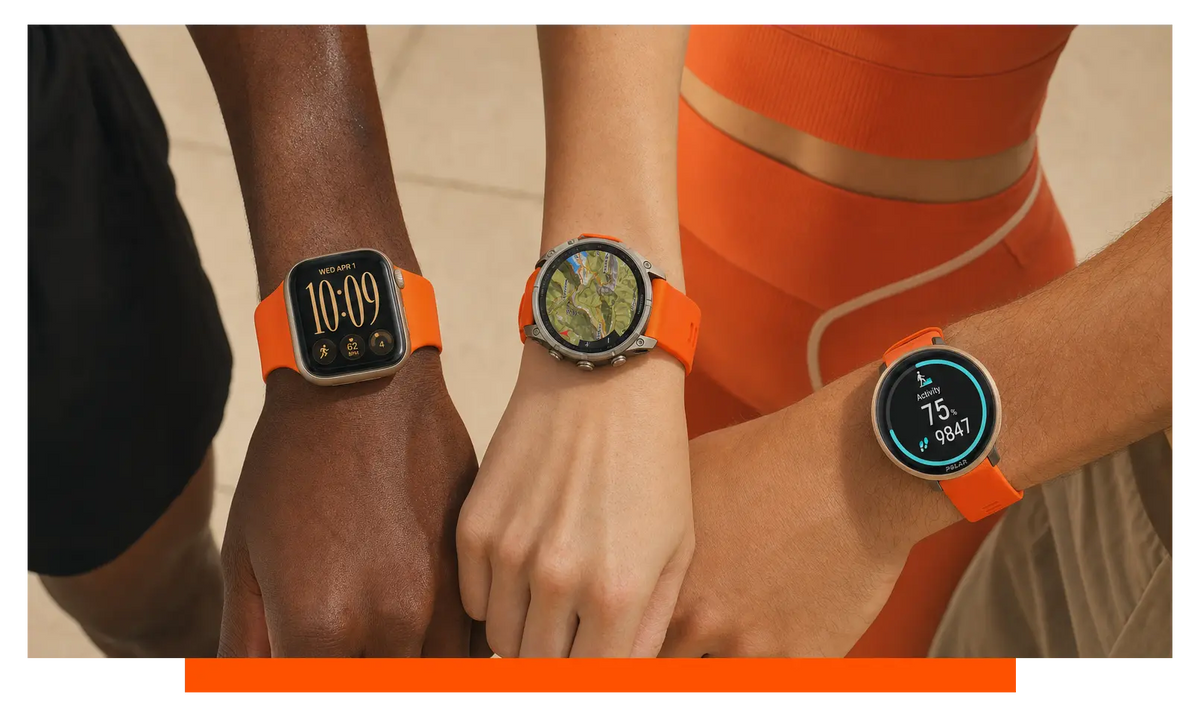
The Apple Watch Series 12 is the best fit here for iPhone users who want everyday workouts and close phone integration. Garmin’s Fenix 9 Pro suits long outdoor sessions; Polar’s Vantage M3 is stronger for structured, recovery-led training. Samsung and Huawei cover bright-screen and cross-platform priorities. Your training style, phone and wrist comfort should decide.
On this page
Use these links to jump straight to the type of fitness watch that matches your training.
- The best fitness smartwatches at a glance
- What makes a good fitness smartwatch?
- Best for iPhone-connected fitness - 1. Apple Watch Series 12
- Best for long outdoor training - 2. Garmin Fenix 9 Pro
- Best for bright-screen everyday workouts - 3. Samsung Galaxy Watch 9
- Best for structured training and recovery - 4. Polar Vantage M3
- Best for cross-platform battery life - 5. Huawei Watch GT 7 Pro
- How to choose a fitness smartwatch
- Frequently asked questions
The best fitness smartwatches at a glance
This comparison shows the one feature most likely to decide each watch’s place on your wrist, rather than rewarding the longest specification sheet.
| Smartwatch | Best for | Deciding fact | Wrist or build factor |
|---|---|---|---|
| Apple Watch Series 12 | iPhone-connected fitness | Up to 10 hours of GPS workout tracking | Silicone, nylon, leather, Milanese and metal straps available |
| Garmin Fenix 9 Pro | Long outdoor training | 18 hours / 32 hours / 56 hours of GPS workout tracking | Titanium case |
| Samsung Galaxy Watch 9 | Outdoor screen visibility | 3,000 nits peak brightness | Silicone, nylon, leather, Milanese, metal and titanium straps available |
| Polar Vantage M3 | Structured recovery-led training | Training Load Pro; offline maps; turn-by-turn guidance | 44mm; 53g; plastic and stainless-steel case |
| Huawei Watch GT 7 Pro | Android and iOS users | Up to 12 days of smartwatch battery life | Titanium-alloy case |
The central choice is phone-first convenience versus training-first endurance, but neither works well if the case and strap become uncomfortable or insecure during sweat, sleep or a long GPS session.
What makes a good fitness smartwatch?
A good fitness smartwatch fits your phone, lasts through your longest session, gives you the level of training guidance you will actually use and remains comfortable enough for consistent wear.
Phone compatibility
Compatibility decides whether the watch can become part of your daily routine rather than a separate fitness gadget. It affects setup, activity syncing and the connected functions available away from training.
This is the first filter. If you use an iPhone and want the watch to behave like an extension of it, an iPhone-focused model makes sense. If you might switch phone platforms, confirmed support for both Android and iOS is more valuable than an extra training metric. Check the maker’s current compatibility requirements whenever support is not explicit.
GPS accuracy and workout battery
GPS workout battery needs to cover your longest realistic activity with spare capacity, not merely a typical gym session. Frequent charging becomes a training problem when you record long runs, hikes or endurance events.
Dual-frequency GPS uses two satellite signal bands instead of one. That can improve positioning among tall buildings and under tree cover, making recorded routes, pace and distance more dependable. It matters most if you run in difficult reception conditions; it is less decisive for indoor training or straightforward outdoor sessions in open areas.
Training guidance, recovery and navigation
Training and recovery tools matter when they change what you do next. Straightforward workout recording is enough if you mainly want a log of gym sessions, runs and daily activity. A structured plan benefits more from training-load or readiness guidance that helps you judge when to push and when to ease off.
Navigation is similarly use-specific. Routable or offline maps are useful for unfamiliar trails and long outdoor sessions, while turn-by-turn guidance reduces the need to stop and check a phone. If you always train on known routes, mapping should not decide the purchase.
Case and strap comfort
Comfort determines whether the watch gathers a consistent picture of your activity and recovery. A case that feels manageable at the start can become distracting after hours of movement or overnight wear, while a loose strap can allow the sensors to shift during exercise.
Strap choice deserves equal attention. Silicone is practical for sweat and easy cleaning; nylon can feel lighter and offers fine adjustment; leather, Milanese and metal are better suited to changing the watch’s everyday appearance. The right fit is secure without being painfully tight, particularly during high-movement workouts.
Best for iPhone-connected fitness - 1. Apple Watch Series 12
The Apple Watch Series 12 is the best choice here if you use an iPhone and want a phone-first smartwatch that also handles everyday training well.
Its Readiness app gives recovery a visible place in the experience, while Precision L1 GPS handles outdoor workout recording. The quoted GPS workout battery is up to 10 hours, so it is suited to everyday runs, gym sessions and day-to-day activity rather than being the obvious pick for the longest outdoor events.
- Phone compatibility: iPhone
- GPS workout battery: up to 10 hours
- Smartwatch battery: up to 24 hours
- Training tool: Readiness app
- GPS system: Precision L1 GPS
The watch was listed at £369 at the time of writing. Its real advantage is convenience: it suits someone who wants fitness tracking, notifications and everyday connected features in one familiar iPhone-centred package.
Fit can be adapted to the activity. Apple Watch 12 straps are available in silicone, nylon, leather, Milanese and metal, so you can use a washable option for training and a different material for work without changing watches.
Best for long outdoor training - 2. Garmin Fenix 9 Pro
The Garmin Fenix 9 Pro earns its place for endurance and outdoor training because its GPS battery options, routable maps and inReach connectivity address problems that appear far from the gym.
The listed GPS workout ratings across the range are 18 hours, 32 hours and 56 hours. That spread matters if a short charging routine could interrupt long-distance training, hiking or an event. Routable maps also give the watch a practical role during unfamiliar outings rather than simply drawing the route after you finish.
- GPS workout battery: 18 hours / 32 hours / 56 hours
- Training and recovery: Stamina Zones
- Navigation: routable maps
- Satellite connectivity: inReach
- Display: AMOLED
- Case: titanium
The Garmin Fenix 9 Pro was listed at £949 in the 43mm size, £949 in the 47mm size and £1,029 in the 51mm size at the time of writing. Choose the case around your wrist and intended wear, not on the assumption that the biggest option is automatically best.
The same principle applies to the band. Silicone, nylon, leather, Milanese and metal options are available among Garmin Fenix 9 Pro 47mm straps. Nylon can reduce the bulky feel during long wear, while silicone is easier to rinse after a wet or sweaty session.
If you are deciding between this training-first approach and Apple’s premium outdoor alternative, our Apple Watch Ultra 4 vs Garmin Fenix 9 comparison takes that choice further.
Best for bright-screen everyday workouts - 3. Samsung Galaxy Watch 9
The Samsung Galaxy Watch 9 is the strongest fit in this list when outdoor screen visibility and close smartwatch-style interaction matter more than long-session navigation tools.
Its display reaches a stated peak brightness of 3,000 nits. That is useful when you need to read workout information quickly in direct sunlight rather than shade the screen or stop moving. Heart Health is the named fitness feature here, placing it closer to everyday wellness and connected use than the mapping-led Garmin or recovery-led Polar.
- Peak brightness: 3,000 nits
- Fitness feature: Heart Health
- 40mm price: £349
- 44mm price: £379
Those Samsung Galaxy Watch 9 prices were read at the time of writing. The smaller case is the sensible starting point if comfort during sleep and repeated wear is important; the larger case may suit you if glanceability during exercise takes priority. Try the intended size where possible rather than deciding from a product image.
The band range gives you another way to tune the fit. Samsung Galaxy Watch 9 44mm straps and Galaxy Watch 9 40mm straps include silicone, nylon, leather, Milanese, metal and titanium options. That is the broadest material spread in this shortlist, and it makes the watch easier to adapt between sweaty workouts and everyday wear.
Best for structured training and recovery - 4. Polar Vantage M3
The Polar Vantage M3 is the best choice for someone who wants recovery guidance, dependable route recording and offline navigation to shape a structured training plan.
Training Load Pro is the deciding tool: it is more relevant to athletes who adjust future sessions around accumulated strain than to someone who only wants a record of completed workouts. Dual-frequency GPS supports route, pace and distance recording in difficult surroundings, while offline maps and turn-by-turn guidance make the watch useful away from familiar roads.
- GPS workout battery: 30 h
- Smartwatch battery: 7 d
- Training and recovery: Training Load Pro
- Navigation: offline maps; turn-by-turn guidance
- Case size and weight: 44mm; 53g
- Display: 1.28 Inch AMOLED; 416 × 416; 1,500 nits
- Storage: 32 GB
- ECG: yes
The Polar Vantage M3 was listed at £349 at the time of writing. Its 44mm case and 53g weight are worth considering together: the screen is easy to glance at during a session, but comfort still depends on your wrist and how snugly you need to wear the optical sensor.
Available Polar Vantage M3 straps include silicone, nylon, leather, Milanese and metal. A finely adjustable nylon band can help stabilise the watch without excessive tightness, while silicone remains the practical option for frequent sweaty sessions.
Best for cross-platform battery life - 5. Huawei Watch GT 7 Pro
The Huawei Watch GT 7 Pro is the practical option if you want confirmed Android and iOS compatibility alongside long smartwatch battery life.
Its quoted battery life reaches up to 12 days, which reduces the chance of skipping sleep or activity tracking because the watch is on charge. This is a smartwatch battery figure rather than a stated GPS workout runtime, so endurance athletes should not treat it as directly comparable with Garmin’s or Polar’s workout ratings.
- Phone compatibility: Android; iOS
- Smartwatch battery: up to 12 days
- Display: 1.47 inches AMOLED; 466 × 466 pixels
- Case: titanium alloy
- Water resistance: 5 ATM
- Dust resistance: IP69
The Huawei Watch GT 7 Pro was listed at £379.99 at the time of writing. Its cross-platform support is the key reason to choose it here: you are less tightly tied to one phone family, while the longer quoted smartwatch battery suits continuous everyday and sleep wear.
Silicone, nylon, leather, Milanese and metal are available among Huawei Watch GT 7 Pro straps. If the titanium-alloy case feels substantial overnight, a lighter and more finely adjustable strap can make more difference than another software feature.
How to choose a fitness smartwatch
Choose by matching the watch to your phone, longest session and preferred level of training guidance, then check that its case and strap will remain comfortable through the full wearing cycle.
- If you use an iPhone and want everyday workouts plus close phone integration: choose the Apple Watch Series 12.
- If you train outdoors for long periods and need routable maps: choose the Garmin Fenix 9 Pro.
- If you prioritise a bright display for outdoor everyday workouts: choose the Samsung Galaxy Watch 9.
- If recovery data and structured training decisions shape your plan: choose the Polar Vantage M3.
- If confirmed Android and iOS support plus long smartwatch battery matter most: choose the Huawei Watch GT 7 Pro.
Feature count is not the winner. The right watch is the one that fits your phone and training pattern, lasts through the sessions you actually do and stays secure without becoming irritating on your wrist.
Frequently asked questions
These answers cover the practical questions that arise once you have narrowed down the watch itself.
Can a smartwatch replace a chest-strap heart-rate monitor for intervals?
Not when interval peaks and recovery readings need to be precise. Wrist tracking can be useful for steady training, but high movement and intense efforts can reduce its accuracy, so a chest strap remains the better tool for targeted intervals.
Can I leave my phone at home and still track a run with GPS?
Yes. Every watch in this shortlist has onboard GPS or GNSS, allowing it to record an outdoor run without the phone being carried.
Will a phone-free GPS run sync to the companion app later?
Yes; take your phone later to sync the stored activity, review it in the companion app or use connected features. The practical choice is still the watch that works with your phone and remains comfortable for the whole session.